Atlas
Source-backed engineering intelligence for understanding every software change before it ships.
Synchronization, the evidence graph, and impact reports run end to end locally; production infrastructure and staging acceptance come next. A live walkthrough is available on request.
The problem
A change can affect code, dependencies, reviewers, and decisions far beyond the visible diff, while the context needed to assess that impact lives across disconnected engineering systems.
The evidence needed to evaluate a software change is usually fragmented across source code, pull requests, reviews, architecture, and documentation. Teams can see the diff, but not the whole system around it.
The approach
Built synchronized GitHub and Notion pipelines that normalize source history into a shared engineering graph, retrieve bounded evidence for a proposed change, and persist a cited report with risk, unknowns, recommendations, and verification steps.
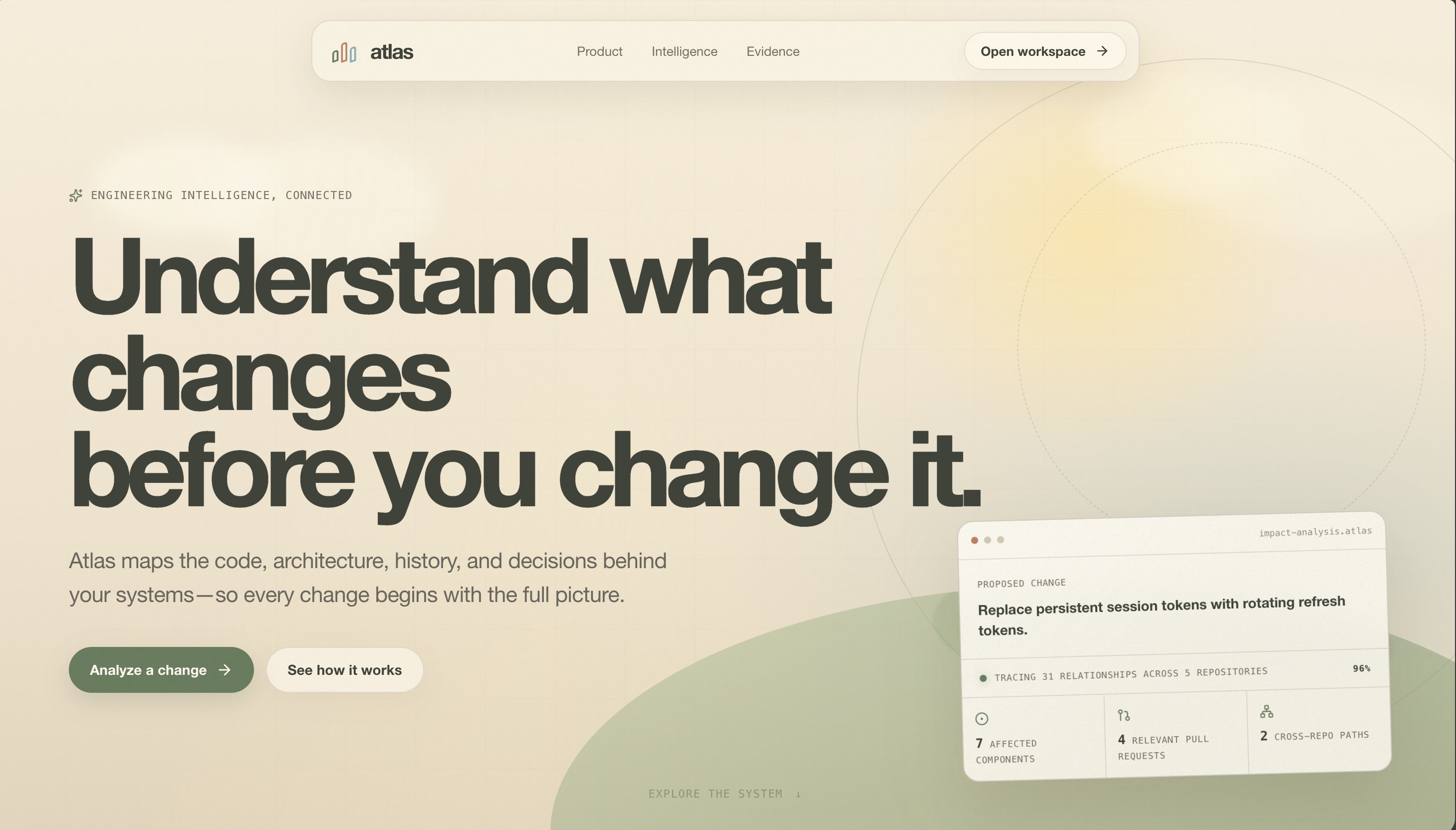
Connects GitHub code, pull-request history, reviews, and Notion decisions in a living engineering graph, then turns planned changes into persisted impact reports with cited evidence.
Defining decision
Make every impact conclusion traceable to persisted source evidence, while keeping GitHub identity separate from narrowly scoped GitHub App repository access.
Separating the API, synchronization worker, and repository checkout volume adds operational complexity, but keeps heavy ingestion away from request latency and makes retries, limits, and failures observable.
How it works
Step through the system. Each stage lists the safeguard that keeps it trustworthy.
Proposed Change
An engineer submits a planned change or selects a synchronized pull request as the analysis scope.
Anchors every report to explicit intent and repository context instead of an open-ended model prompt.
Architecture notes
- A Next.js application handles the marketing and authenticated workspace while a NestJS API owns connector, graph, analysis, and operations boundaries.
- BullMQ workers process GitHub and Notion synchronization through Redis; PostgreSQL with pgvector stores workspace data, indexed intelligence, provenance, and reports.
- Better Auth handles GitHub identity separately from GitHub App repository authorization, keeping connector access explicit and least-privileged.
Implemented system proof
Built and working
- GitHub App ingestion for repositories, commits, pull requests, reviews, actors, and bounded history
- Notion OAuth, resource selection, document revisions, editor provenance, and incremental synchronization
- Planned-change and pull-request analysis backed by a cross-repository graph and persisted citations
Engineering signals
- Independent web, API, worker, and migration release images
- PostgreSQL/pgvector with Redis-backed queues and distributed limits
- Container acceptance covers migrations, readiness, backup/restore, and shutdown
What’s next
Provision production PostgreSQL, Redis, connector credentials, and callbacks, then complete staging analysis, backup-and-restore, rollback, and release acceptance against real workspace sources.