Build deep dive / Product Frame
Execute
An approval-gated agent for creating, inspecting, and operating deterministic business workflows.
Turns natural-language requests into validated proposals, requires explicit approval before mutations, and reuses a strict workflow executor for observable actions.
Product proof
Real interface / landing surface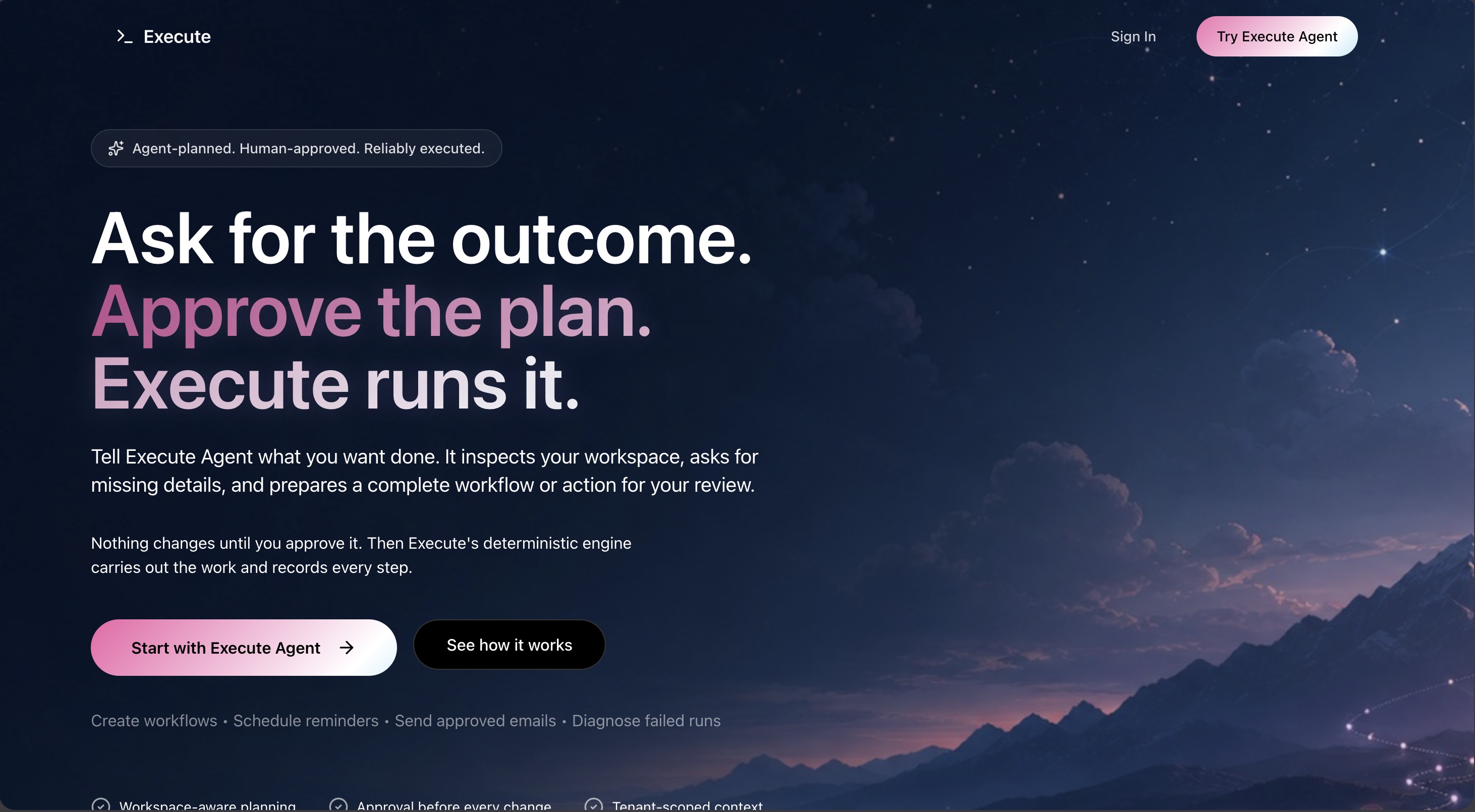
Why this exists
Most automation agents make it difficult to know what the model inspected, what it intends to change, and whether a mutation can be executed safely for the correct workspace.
Product approach
Built a bounded agent tool loop that inspects tenant-scoped state, converts requested mutations into expiring proposals, validates them, and executes only after explicit approval.
Architecture walkthrough
From intent to outcome.
Follow the product path one boundary at a time. Each stage exposes the responsibility it owns and the failure it is designed to prevent.
Interactive execution trace
Stage 01 / 05
Request
The user describes an operational intent through the agent interface.
Boundary protected
Treats language as intent, not immediate authority to mutate workspace state.
Engineering judgment
The decision that shaped the system.
Decision record / 01
Keep model reasoning separate from mutation authority: every write becomes a persisted, validated proposal that the user must approve before deterministic code executes it.
Tradeoff
Approval gates add one deliberate step to agent actions, but make mutations inspectable, idempotent, tenant-safe, and much easier to trust.
Next step
Use internal-release telemetry and failure findings to tighten tool selection, proposal quality, and guided recovery before general availability.
What this proves
Tenant-scoped tools for workflows, executions, forms, contacts, and integrations
Persisted create, update, run, retry, cancel, and disconnect proposals with explicit approval
Failure monitor with deterministic classification, redacted evidence, and guided repair actions
Architecture notes
Bounded tool rounds, result-size limits, prompt-injection defenses, and provider fallback control the agent runtime.
Persisted proposals use validation, expiry, idempotent decisions, and stale-state protection before execution.
Failure findings are tenant-scoped, deduplicated by execution, classified deterministically, and stored with credential-redacted evidence.
Production signals
Internal-release feature controls
Per-call token and latency tracking
Atomic daily usage limits
End of case study